Get 20% cashback
Add your card number at checkout — 20% of the policy price is sent to that card right away.
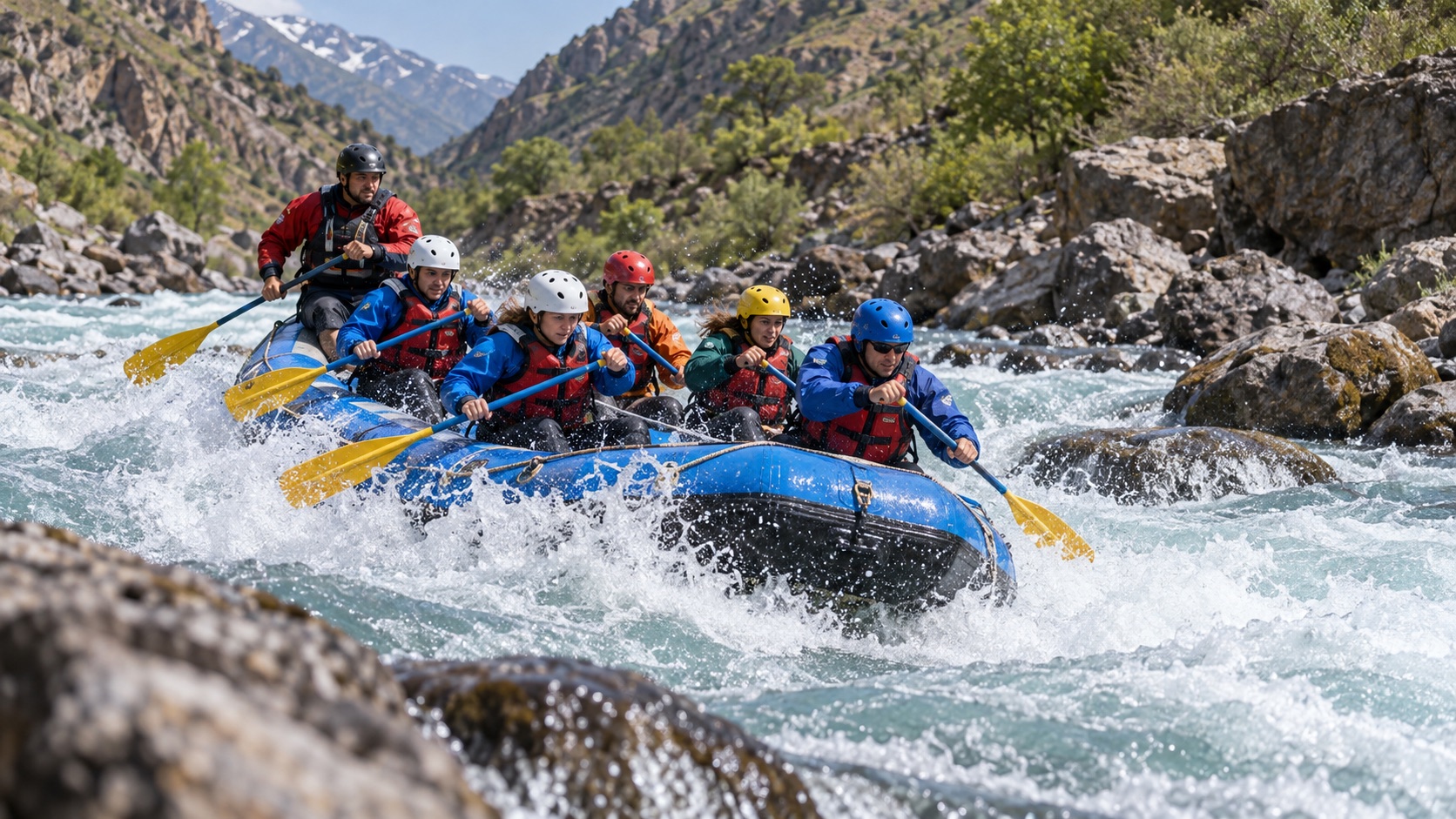
Rafting means running a mountain river in an inflatable raft with a crew of 4–6, led through the rapids by a guide. Kayaking is a related format: the same kind of river, but solo in a kayak instead of a crewed raft. The nearest river for rafting is the Ugam, 75–100 km from Tashkent, with tours running from March to October.
Let's be upfront: of the three well-known rivers in the region, you can currently book a one-day trip only on the Ugam; more on the Chatkal and Pskem below. Rafting and kayaking fall under risk group 6 (extreme sports), and the policy is priced by that group.
There are three well-known rivers, but access differs: the Ugam is a one-day guided trip, while the Chatkal and Pskem today are expedition territory, not tour-package destinations.
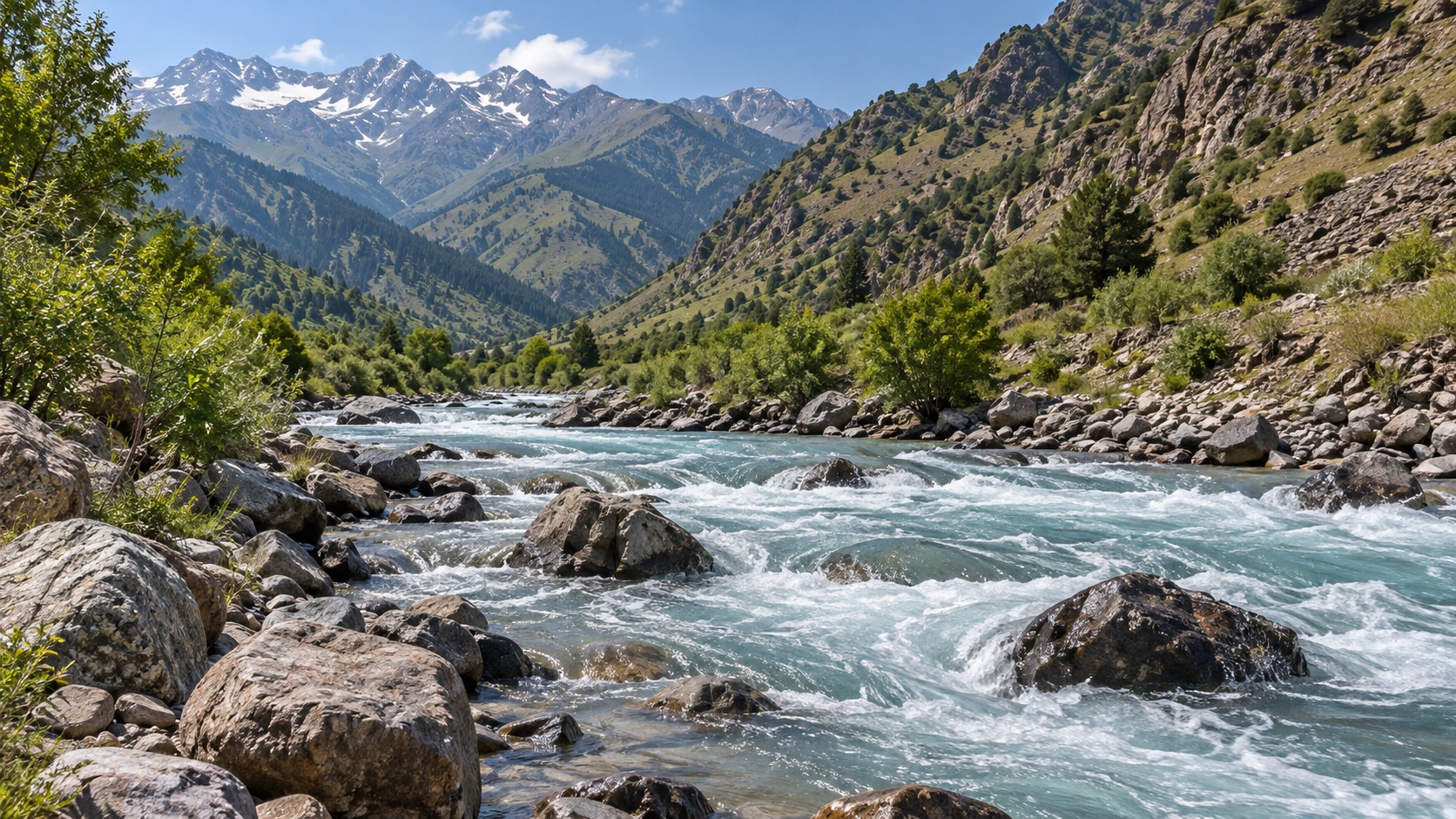
The country's main commercial rafting river: home to Uzbekistan's national rafting center, and in June 2025 it hosted an international competition with teams from 10 countries. Suitable for first-timers and returning rafters alike; no prior experience needed.
A legendary river for experienced paddlers. But today it's an expedition, not a tour. As of 2026, multi-day trips here aren't sold: the river runs through a border zone, and permits have gotten harder to arrange since 2024.
The full Oygaing-Pskem route is Class VI, the highest difficulty category, in the same league as the Çoruh in Turkey and the Blue Nile. The lower section is easier, Class IV: that's where rafting beginners start, but only with experienced guides.
Knowing the weak points helps you prepare ahead of time: choose the right gear and listen closely to the safety briefing on shore. The numbers come from international studies of commercial rafting and kayaking (the US and New Zealand); there's no such data for Uzbekistan.
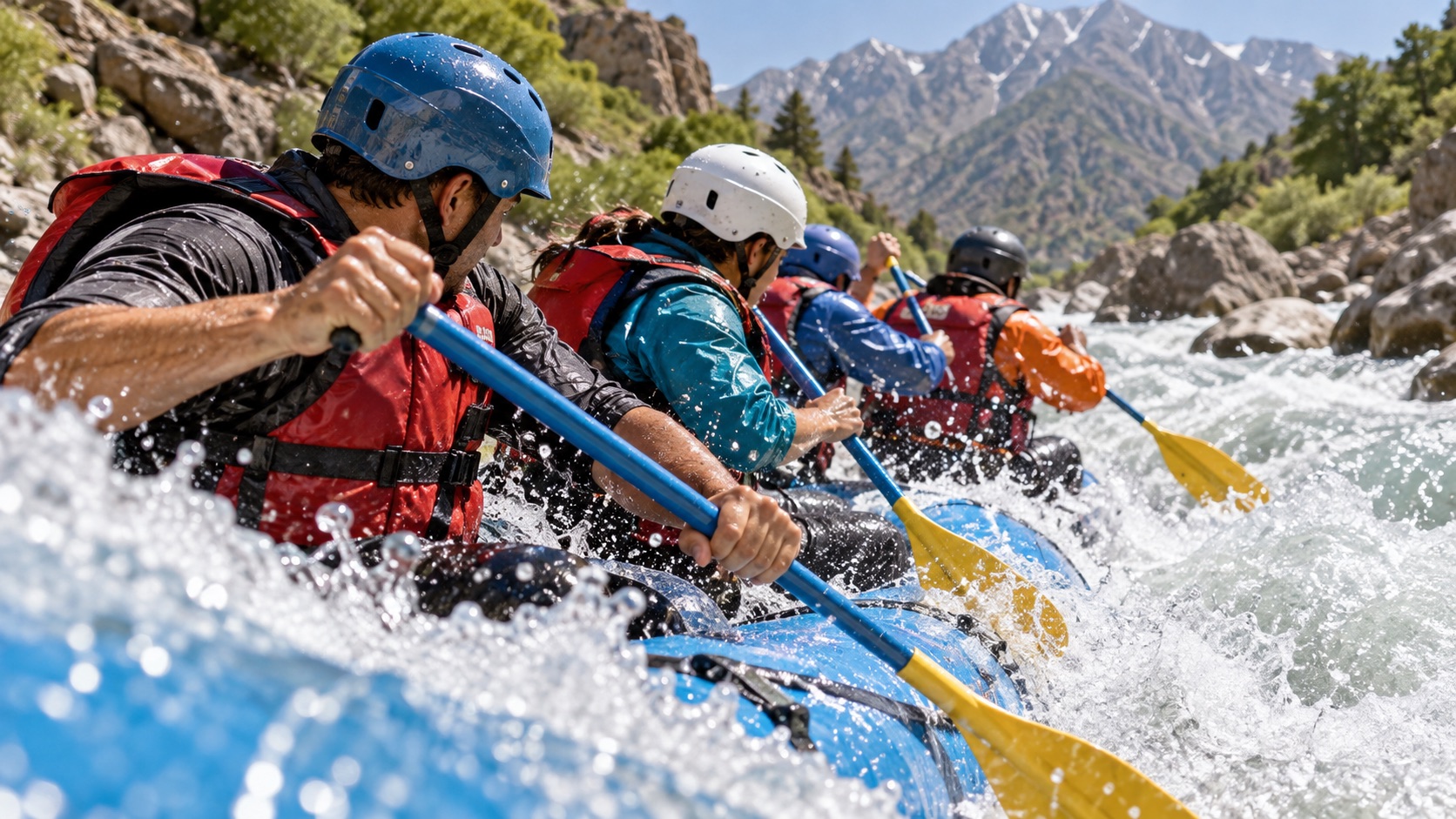
The face accounts for 33.3% of injuries in commercial rafting: usually not from falling into the water, but from a paddle strike or a collision with another rafter inside the boat.
The knee accounts for 15.3% of injuries among rafters, and the arm and wrist for 11.6%. For kayakers, the shoulder is the main weak point: dislocations and overuse injuries from paddling. For serious injuries, kayaking is roughly five times riskier than rafting.
Injuries are rare on guided trips: 0.26–0.44 per 1,000 person-days. Severe whitewater incidents are most often linked to cold, fast water and rafting without a life jacket. That's why Ugam operators issue a life jacket and helmet to everyone, and run a mandatory safety briefing before the start.
In 2026, people died on the Pskem and at Charvak Reservoir while out on the water without life jackets, on a SUP board and in a motorboat. And if someone is seriously injured on the river, they sometimes need to be taken to hospital: that's medical transportation.
Data: international studies (US, New Zealand), not Uzbekistan statistics: Whisman & Hollenhorst, Journal of Wilderness Medicine (1999); Attarian & Siderelis, Wilderness & Environmental Medicine (2013); Fiore, Clinical Journal of Sport Medicine (2003); Franklin & Leggat (2012); American Whitewater incident database (1975–2016).
An injury on the river shouldn't leave you scrambling to pay for treatment. The athlete accident policy pays out, so you can focus on recovery, not costs. It usually isn't included in the tour price; you buy it separately.
A cut from a paddle strike, a knee injury, a kayaker's shoulder dislocation: if it's recognized as an insured event, you receive a payout. Its amount depends on the nature of the injury and the sum insured you chose.
The sum insured ranges from UZS 10 to 50 million: the higher it is, the larger the payout for the same injury. Total payouts for the year never exceed the sum insured you chose.
The policy runs for a full year: enough for the whole season from March to October, with no need to buy a new one for every trip to the river.
Rafting and kayaking are classed as extreme sports. Read more about insurance for extreme sports. What extreme sports insurance is and how it works: see the glossary.
The athlete accident policy protects you during training, training camps and competitions.
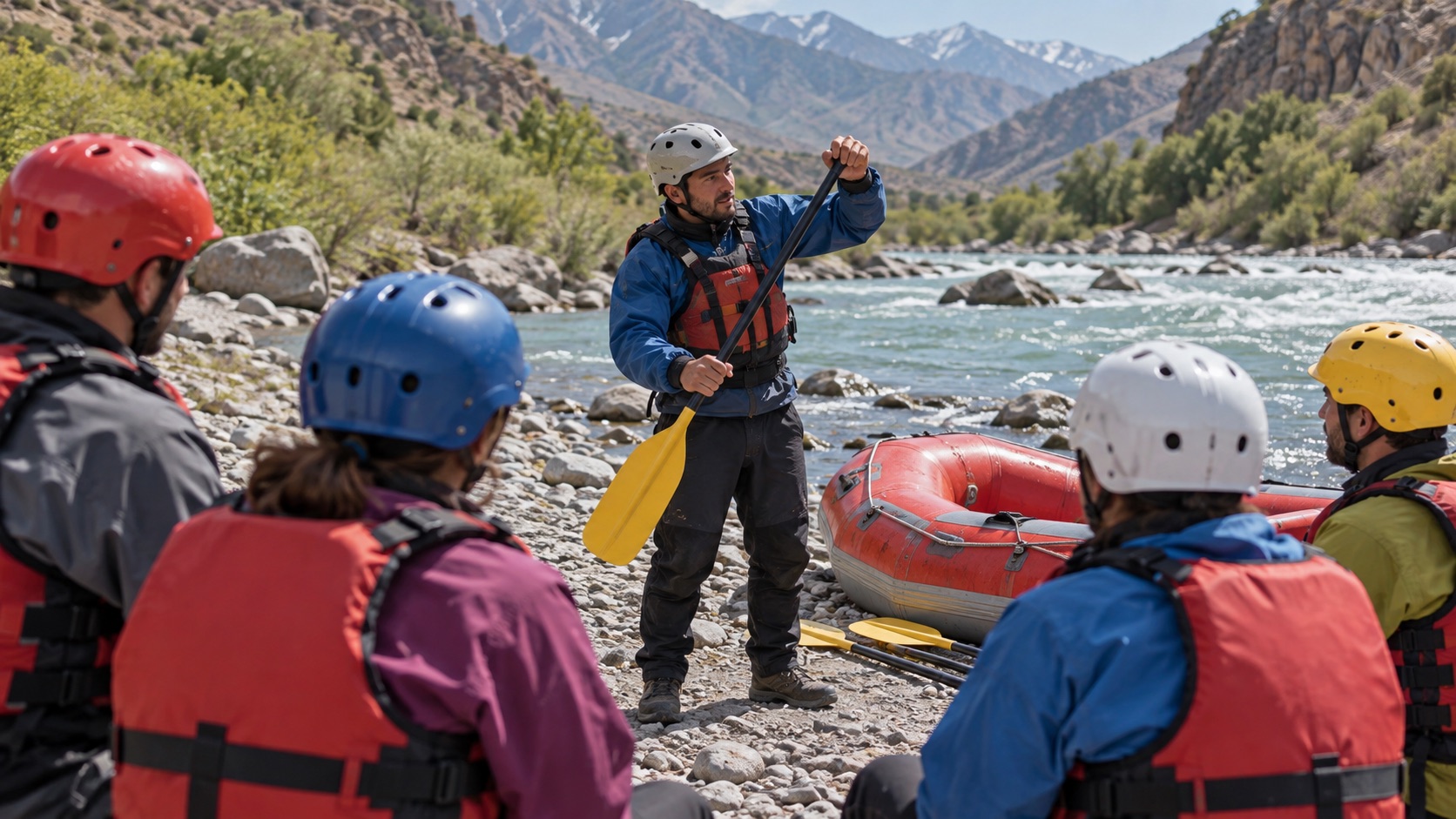
Training with an instructor or at a rafting or kayaking school.
Regular training at a sports club.
Training camps lasting several days or weeks, and competitions, from local to international level, such as the one held on the Ugam in 2025.
See a doctor and keep all medical documents.
Contact EUROASIA by calling 1147 within 30 days of the incident.
Submit your documents within 3 months: passport, a discharge summary or certificate from the medical facility, X-ray, CT or MRI images for fractures, and a medical report confirming you weren't intoxicated. For disability: a report from the authorized state medical commission (VTEK). In case of death: a death certificate.
Receive your payout within 15 business days after the claim report is signed.
The policy takes effect 3 calendar days after payment, so buy it in advance, before you head out on the river.
Also read: Sports insurance in Uzbekistan: who must insure the athlete?
The formula is the same for every sport; for rafting the coefficient is 5.0. From there, the price depends only on the sum insured.
Premium = sum insured × 0.5% × coefficient
Sum insured: from UZS 10 to 50 million. The coefficient depends on the sport's risk group.
10,000,000 × 0.5% × 5.0
50,000,000 × 0.5% × 5.0
Canoe and kayak paddling fall under the same risk group 6, so kayaking is priced the same way.
All sports and risk groups are on the sports insurance page.
The premium is calculated using the formula: sum insured × 0.5% × the sport's coefficient. The coefficient for rafting is 5.0: with a sum insured of UZS 10 million, a one-year policy costs UZS 250,000; with UZS 50 million, it's UZS 1,250,000. For the exact price, use the calculator on this page.
Under the public offer agreement (clause 5.1), the policy applies during training, training camps and competitions. Not sure if your format qualifies, for example a one-off guided tour or rafting on your own? Call 1147 to check before you buy.
Travel insurance is designed for trips abroad: if you're going rafting outside Uzbekistan, that's the policy you need. For rafting and kayaking inside Uzbekistan, there's the athlete accident policy: it pays you after an accident, and in the worst case, pays your family.
According to international studies of commercial rafting, the face is injured most often: 33.3% of injuries, usually from a paddle strike or a collision inside the raft. Next come the knee (15.3%) and the arm or wrist (11.6%), while for kayakers the shoulder is the main weak point. There's no data for Uzbekistan, but injuries are rare on guided trips with a life jacket and helmet.
Yes: Ugam operators give everyone a life jacket, helmet and paddle, and run a mandatory safety briefing before the start, covering how to hold on in the raft, how to paddle, and what to do if you fall in the water. If you can't swim, tell your guide beforehand. The accident policy usually isn't included in the tour price; you buy it separately.
A one-day guided trip can currently be booked on the Ugam, 75–100 km from Tashkent, with a season from March to October. The Chatkal and the Pskem-Oygaing are rivers of the highest difficulty class, but they lie in a border zone, and multi-day trips there aren't currently sold. That's expedition territory, not a tour package.
Send us your question and we'll reply shortly

 English